

The GenX generation that grew up analog... and how we became ClerkHound...
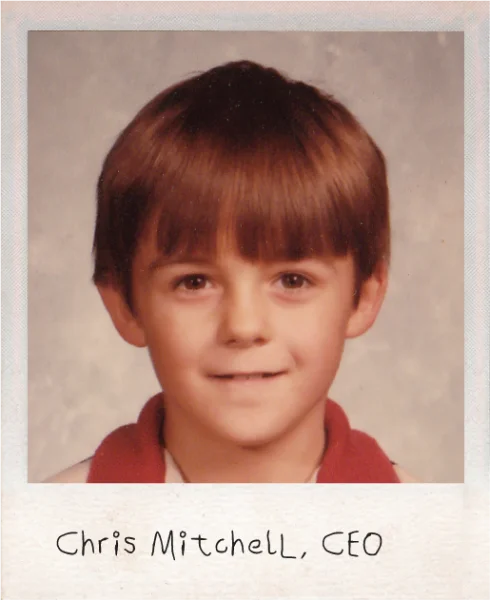
Designer, engineer, and musician, Chris Mitchell, has always hated computers and software for as far back as he can remember. Then at 11 years old, a circle changed his life...
When I was 11 years old, I was forced to take a computer class, like practically every other kid in the '80s. We were told computers were the future and that we'd all need to learn programming.
To ease us into it, they introduced us to a language called Logo, which taught kids to draw using lines of code.
I hated every minute of it.
I could already draw with a pencil, and I loved doing it. Why would I want to type REPEAT 4 [ FD 50 RT 90 ] just to draw a square? My project partner, Corey, and I spent most of our time goofing off. At one point, we randomly typed a string of commands and accidentally drew something resembling a boot.
That was the highlight of my programming career.
At least, for the moment.
Not long afterward, my cousin Troy invited me over to see his new computer. It was called a Macintosh. I couldn't have cared less, but I figured we could play G.I. Joe if nothing else.
He sat me down in front of this little beige box, opened an application called MacPaint, and handed me something called a mouse.
With one click and a simple drag, I drew a perfect circle.
I was stunned.
Here's the thing. I'd always hated drawing circles in art class. Compasses, protractors, shaky hands. I could never get the circle to be tangent at the end. The two lines would almost always overlap...
But there it was. A perfect circle.
Maybe computers weren't so bad after all.
By college, I'd discovered that typing and saving papers on a computer was a hell of a lot easier than retyping entire pages on a typewriter. I was already using Macs in the music lab for music theory and printing scores on a terrible dot matrix printer.
What a time to be alive.
Around that time, my band, Wallace Green, hired a graphic designer to create a logo. What we got back was garbage. I paid her the $200 anyway, but we weren't using it.
After hiring another designer, I took the new artwork to a T-shirt shop. The owner printed out a quote with his logo, and I couldn't believe how clean the artwork looked.
"Why does that look so good?" I asked.
"It's vector artwork."
"What's vector?"
He explained it with all the enthusiasm of an 85-year-old man yelling at kids to get off his lawn. The guy was about 23, but apparently already tired of humanity.
Still, that conversation changed everything.
I discovered Adobe Illustrator and fell in love with drawing with computers. Before long, I was designing logos, album covers, books, and the visual identity that would eventually become Pladd Dot Music.
After college, I started teaching guitar full-time in my own studio. I learned to build websites, and two years later, opened a music school with a retail storefront.
As the business grew, I discovered that the software I needed didn't really exist. So I started building FileMaker databases, developing websites for regional clients, and eventually wrote my first SQL database.
I hated every minute of writing that database, by the way.
I loved designing things, but I never wanted to learn to code.
Eventually, we expanded into manufacturing guitars and amplifiers. All those years of vector drawing paid off again as I began creating 3D models and programming CNC machines.
Funny how one thing leads to another.
One Monday morning, I arrived at work, fired up our point-of-sale system, and was greeted with a message saying my software license had expired.
That's funny. I owned a perpetual license.
So I called the developer to ask them what was going on.
The developer was pushing customers toward a new cloud-based product. Unfortunately, their new software was terrible. Worse, they wanted roughly $600 more per month for features I'd already purchased. I explained to them that I currently had over $125,000 in open purchase orders from schools and I REALLY NEEDED to access my data.
Their explanation? They no longer supported the desktop version. In other words... not my problem.
That's a bunch of bullshit.
The next morning, I changed my computer's internal clock back three days. The software had worked perfectly on Saturday, and nothing had been updated since.
It fired right up.
They'd apparently programmed an expiration date into software I'd already paid to own.
I was furious.
So I went looking for developers.
That's how I eventually met Russell and Laura.
Russell understands all the code I never wanted to learn. He's brilliant at anticipating technical problems before they happen. Laura has an incredible mind for software business logic, even if my obsession with design details—like the radius of a button's corner—occasionally drives her crazy.
And me? I'm still the kid who just wants to draw a perfect circle.
I could tell you our meeting was fate, that everything happened at exactly the right time, and that there was a little magic involved.
And I'd believe every word of it.
The three of us became ClerkHound.
We build software because we believe it can be better. More intuitive. More thoughtful. More useful. We constantly question what we've built, challenge ourselves to improve it, and refuse to accept that something is good enough simply because it works.
It's funny. At 11 years old, I couldn't understand why anyone would want to draw with a computer.
Today, I help design the software people use to run their businesses.
I'm still the guy that got mad at a software company for trying to feed me dogfood and tell me it was steak.
And I still don't write code.
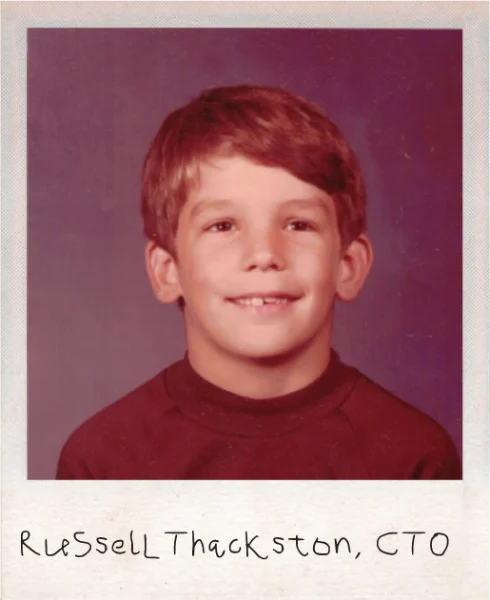
ClerkHound's CTO (Chief Technical Officer), Russell Thackston, lives in Atlanta, GA
My first computer was a TRS-80 from Radio Shack, bought by my parents. It stored programs on cassette tapes. No disks. Certainly no cloud. Just a computer, a tape recorder, and programs you typed in from a magazine.
I loved it.
A few years later, I asked a friend to make me an engraved sign for my door:
“Russell Thackston, Computer Programmer.”
No qualifications. No customers. Just a little sign of things to come. I still have it in a box around here, somewhere.
Apparently, I’d settled the career question pretty early.
The TRS-80 gave way to a Commodore 64, then a 286 PC, followed by a succession of computers from every generation.
I spent weekends building elaborate programs, websites, and open-source software because I enjoyed making things work and helping people solve problems. Give me an interesting topic and a keyboard, and there goes my free time for the next two months.
Professionally, that eventually led to building software for companies including The Home Depot, where I was the tech lead for a 15-person development team creating a point-of-sale system used across five countries.
It also taught me that troubleshooting requires asking the right questions.
I recall an instance when a cashier called to report that their touchscreen wasn’t working. We spent the better part of an hour trying to diagnose the problem before finally deciding to send them a replacement monitor.
They were delighted. The old one, they explained, had a great big gash in the screen where a forklift had hit it.
That detail would have been useful slightly earlier.
Along the way, I earned a PhD in Computer Science and Software Engineering from Auburn and taught as a professor at Georgia Southern University.
I wanted more control over my work and a little distance from corporate culture. As it turns out, universities have a culture of their own.
But I loved my students!
Many were smarter than I’d been at their age, which was both encouraging and humbling. Helping someone work through a difficult concept and reach that “aha!” moment was enormously satisfying.
I spent years teaching students how to build web applications, work with cloud technologies, and turn ideas into working software.
Then Chris called with an idea.
A Small Side Project
He wanted to know if any of my students might like to help him with a side project.
The side project was writing an entire point-of-sale system. From scratch.
I suggested that it might be a slightly larger undertaking than he had in mind.
Then I spent several days thinking about it, called him back, and offered to help in my spare time.
Apparently, recognizing the monumental size of a project and volunteering to develop it anyway is perfectly normal.
We made tremendous progress that summer. Meanwhile, I was becoming increasingly ready for a change in my university career. When August rolled around, I decided to leave teaching and commit myself full-time to ClerkHound.
After years of filling my weekends with software projects, I started building a business around one.
The best part has been getting to know the people using it.
When Danny’s Fabric and Yarn opened its doors, we were right there with them. Since then, we’ve talked about increasing sales, their first online order, and the milestones that come with getting a business off the ground.
In my own small way, I’ve gotten to celebrate those things with them.
That means a lot to me.
The impersonal nature of so many software companies has always bothered me. When a merchant calls, I want to know who’s calling and what’s happening in their business.
My greeting is usually something like, “Hey Danny! How’s it going?”
I’m fairly sure I know more about some of our customers than I do about the couple I’ve lived next door to for the better part of a decade.
That probably says something about my neighborly skills. But it also says something about what we’re building.
I still love an interesting problem and a keyboard. These days, I get to know the people whose problems I’m solving—and hear what happens when we get it right.
The sign on my door had the job title right.
I just didn’t know how much I’d enjoy it.
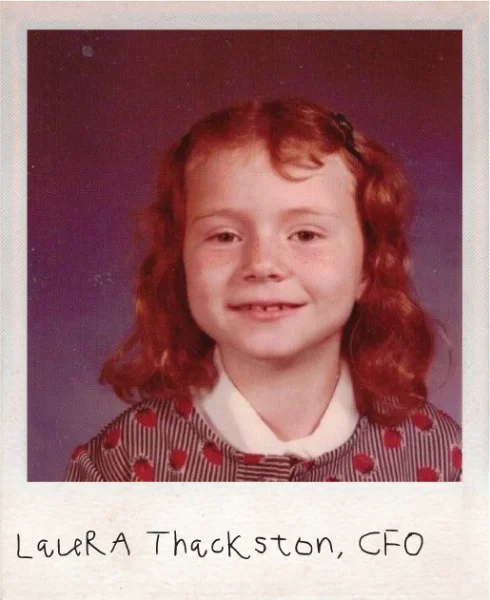
Laura Thackston is ClerkHound's CFO. Don't let the title fool you. It's more than the books... She codes, she plans, she solves...
I started my career at TSYS straight out of college—or technically, before I graduated. I hadn't even picked up my diploma when I started the job. Three months later, I went back for graduation, diploma in hand and absolutely no idea what a Business Analyst actually did.
What I did know was how to solve problems. I'd been doing that since I was 12, working in my parents' print shop and learning that there's usually a better way to get something done if you're willing to figure it out.
Turns out, that skill travels pretty well.
Over the next 20 years at TSYS, I wore just about every hat they could find for me: Business Analyst, Programmer Analyst, Trainer, Tester, Product Lead, Conversion Lead, Process Improvement … the list goes on and on. If something needed fixing, improving, explaining, or figuring out, I was happy to jump in. I like being useful, and I like making life easier for the people doing the work.
One of my favorite projects involved redesigning screens to make complicated processes simpler for the people using them. One design ended up becoming the default screen for all clients and was described as a prototype for future implementations. Not bad for someone who started out not knowing what a Business Analyst was.
Today, I'm bringing that same problem-solving instinct to ClerkHound. I work across the product, from payment integrations and software design to testing, troubleshooting, and the seemingly endless list of details that can make or break a good piece of software.
Chris and Russell have their own talents. I have a talent for asking, "But why are we doing it that way?"—usually followed by a suggestion to do it differently. I'm sure this brings them immeasurable joy.
I'm also responsible for some of the cheekier messages you'll find around ClerkHound. I believe software can be useful without being boring, and there's no reason a little personality can't sneak into the experience. If a message makes you laugh, I've probably had something to do with it. If it makes you laugh and feel slightly called out, that was definitely me.
I'm honest. Sometimes brutally so. I say the things other people are thinking but don't necessarily want to say out loud. This occasionally gets me into trouble, but I'd rather have an honest conversation and fix a problem than politely pretend everything is fine.
At the end of the day, that's what drives me: solving problems, challenging the status quo, and making things work better for the people who depend on them. I've spent decades doing it in payments, and now I get to help build something that puts those lessons to work for businesses like yours.
Just don't expect me to keep quiet if I think we can do it better.